INSIGHT Market Comment
The global financial media is currently hyper-focused on South Korea’s semiconductor dominance, specifically its pivotal role in the AI revolution through High Bandwidth Memory (HBM). While SK Hynix and Samsung Electronics rightfully command attention, this chip-centric narrative is overshadowing another sector where South Korea holds an undisputed global monopoly: High-value Shipbuilding and Marine Engines.
When global investors look at the Korean market (KOSPI), they often see it as a proxy for the global tech cycle. However, beneath the surface of the AI boom, a completely different “Super-Cycle” is structurally unfolding in the shipyards of Ulsan and Geoje. If you are looking for alpha in the Korean market, it’s time to look beyond the fab and towards the dockyards.
1. The Undisputed Kings of High-Value Vessels
While China has aggressively expanded its shipbuilding capacity, taking a large chunk of the low-margin bulk carrier market, South Korea has strategically cornered the market for high-value, technologically advanced vessels.
Whenever the world needs LNG (Liquefied Natural Gas) carriers, VLCCs (Very Large Crude Carriers), or next-generation eco-friendly ships powered by ammonia or methanol, the global shipping industry turns to the Korean Big 3: HD Hyundai, Samsung Heavy Industries, and Hanwha Ocean. In these premium segments, Korean shipbuilders effectively operate as an oligopoly, leaving global competitors far behind in both technological prowess and delivery reliability.
2. A Perfect Storm of Demand: Decarbonization and Geopolitics
Why does this matter right now? The global maritime industry is being hit by a perfect storm that guarantees sustained, structural demand for new ships:
- The Decarbonization Mandate (IMO 2050): Strict environmental regulations are forcing shipping companies to scrap older, polluting vessels and replace them with eco-friendly alternatives. This is not a cyclical trend; it is a regulatory mandate forcing a total fleet renewal.
- Geopolitical Shifts: The ongoing geopolitical tensions in the Middle East and Eastern Europe have drastically altered global energy supply chains. As energy sources diversify (e.g., more LNG shipments from the US to Europe and Asia), the “Ton-Mile” (the volume of cargo multiplied by the distance it travels) is skyrocketing. Longer routes require more ships just to transport the same amount of energy.
3. The Unexpected AI Beneficiary: Marine Engines for Data Centers
Perhaps the most fascinating—and least understood—development in this sector is the intersection of shipbuilding and the AI boom.
AI data centers are massive power consumers. To prepare for potential power grid shutdowns, these tech giants require massive emergency generators. Traditional 1~3MW generators are no longer sufficient due to space and control system limitations. Big Tech’s solution? Large-scale 20MW+ 4-stroke medium-speed marine engines, the very same engines used to power massive vessels.
Furthermore, to meet strict carbon neutrality (RE100) goals, data centers require dual-fuel technology (burning methanol or LNG). The only companies in the world capable of mass-producing these highly reliable, dual-fuel mega-engines are Korean marine engine manufacturers. This transforms traditional heavy machinery companies into “AI Infrastructure Tech Stocks,” triggering a fundamental re-rating of their multiples.
💡 Plan B Insight:
The Alpha: The most critical metric for investors to watch is the Newbuilding Price Index, which recently hit levels not seen since the historic super-cycle of 2008. Korean shipbuilders are currently sitting on a massive 3 to 4-year order backlog. Because their dockyards are entirely full, they are no longer competing on price. They now possess absolute Pricing Power, allowing them to cherry-pick only the most profitable orders. This transition from volume-driven growth to margin-driven profitability is the core catalyst for the sector’s impending earnings surprise.
4. Key Stocks to Watch: HD Hyundai Heavy Industries & Hanwha Engine
For global investors seeking exposure to this super-cycle, two companies stand out with distinct investment narratives:
- HD Hyundai Heavy Industries (HD현대중공업 /329180/KOSPI): The undisputed global leader in shipbuilding. It recently secured a massive $450M (627.1 billion KRW) contract to supply medium-speed “HiMSEN” engines for AI data centers in the US, proving its technological edge. While its market dominance is unmatched, its stock price has already surged significantly, reflecting much of this premium.
- Hanwha Engine (한화엔진/082740 /KOSPI): A pure-play marine engine manufacturer offering a highly attractive entry point. The company recently posted an earnings surprise and is aggressively expanding its capacity by investing $60M (80.2 billion KRW) into a new factory dedicated to 4-stroke medium-speed engines, expected to operate later this year. The market has yet to fully price in its potential data center contracts, making it a compelling “growth-at-a-reasonable-price” (GARP) play.
5. Why Now? A Healthy Correction Offers a Rare Entry Point
Over the past week, the Korean shipbuilding sector has experienced a surprisingly sharp correction, despite reporting stellar earnings and an expanding order book.
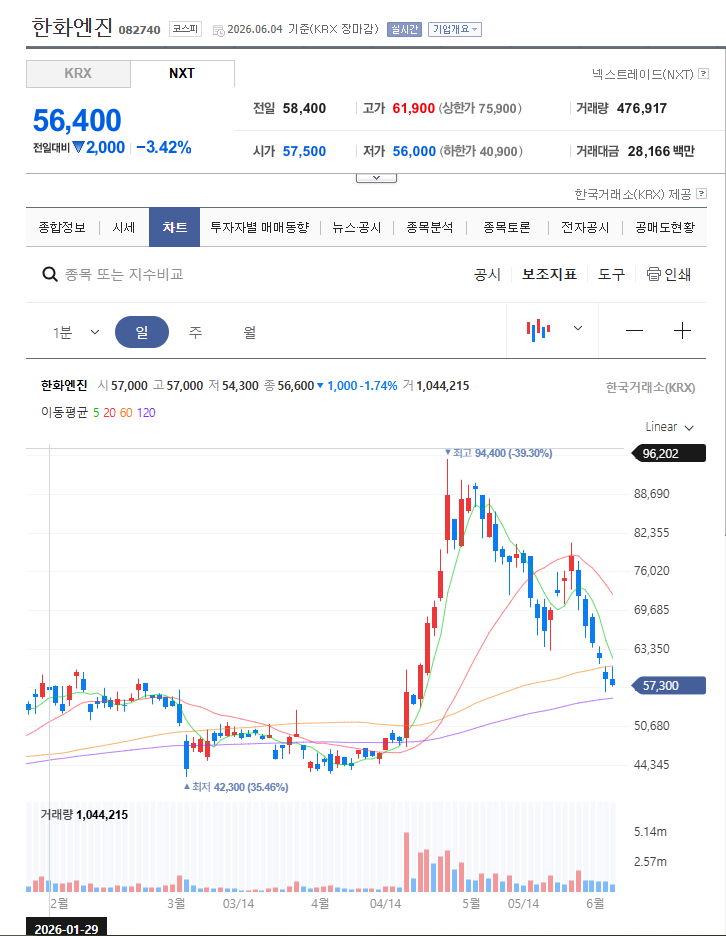

In the stock market, such pullbacks during a structural super-cycle are rarely driven by deteriorating fundamentals. Instead, they are typically “period adjustments” where the stock price takes a breather to let the actual earnings catch up with the fast-running expectations, sometimes exacerbated by short-term noises like summer labor union negotiations.
The Bottom Line: For short-term traders, this volatility might be daunting. But for astute global investors who understand the mega-trends of energy diversification, fleet renewal, and the new AI data center engine market, this recent pullback offers a highly attractive, low-risk entry point. The narrative is rapidly transforming into hard numbers—don’t let the semiconductor hype blind you to the roaring engines of Korea’s shipyards.
All content on this blog reflects my personal investment journey and is not financial advice. Investment decisions and their outcomes are solely your responsibility.