
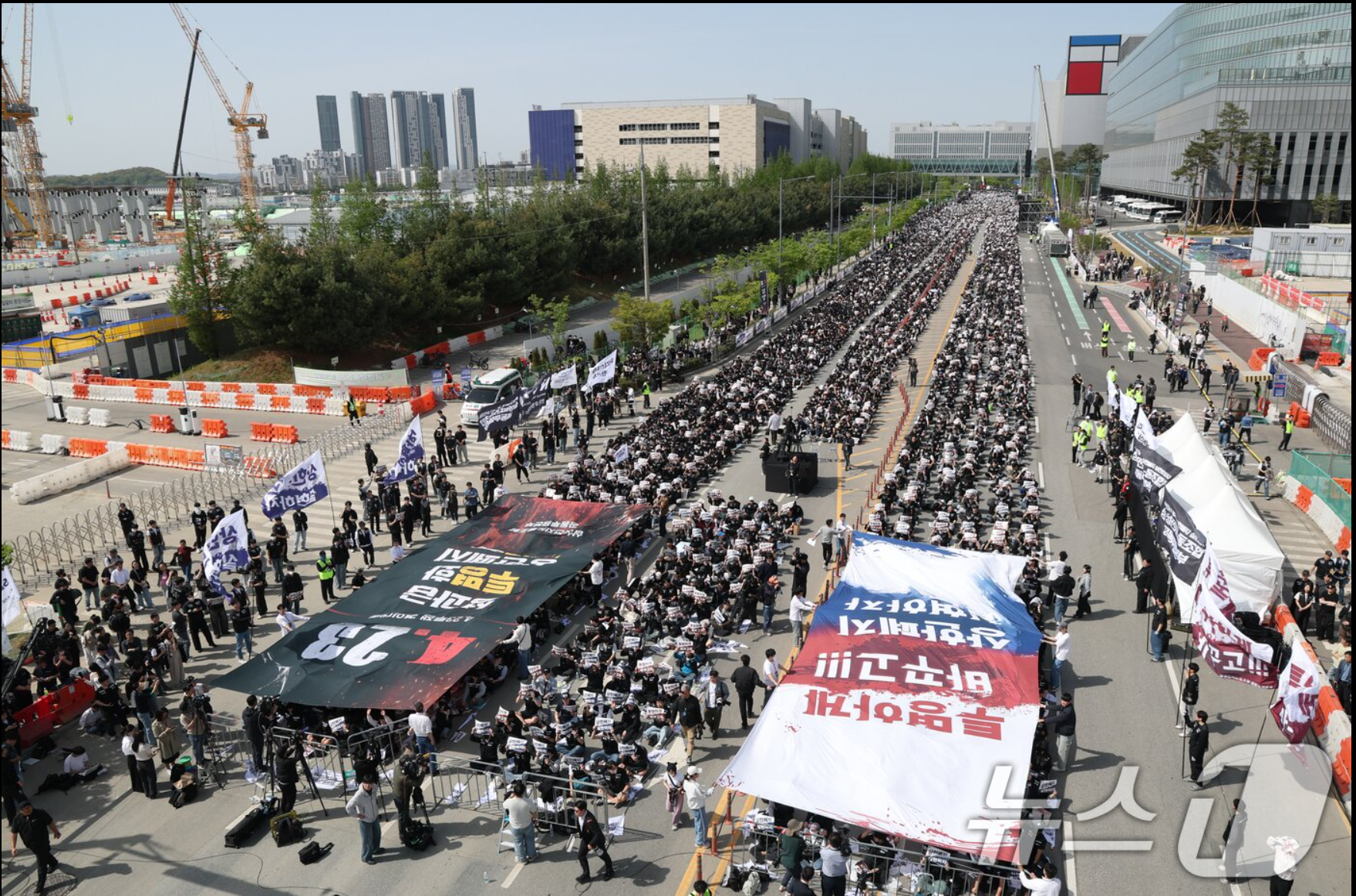
 © News1 / Reporter Kim Young-woon, April 23, 2026
The legendary No-Union myth of Samsung Electronics has officially dissolved into the silence of the Giheung and Pyeongtaek campuses. For the first time in its 55-year history, the tech giant is facing a coordinated strike. While global headlines focus on potential production delays, they are missing the deeper, more structural shift: This labor crisis is the ultimate catalyst that will force Samsung to automate its way out of human dependency.
Hidden Story The HBM Shadow and the Envy War
The roots of this strike aren’t just about wages; they are about a bruised ego. For the past three years, Samsung’s semiconductor division (DS) struggled as SK Hynix dominated the HBM (High Bandwidth Memory) market. When SK Hynix agreed to share 10% of its operating profit with employees, it set a benchmark that Samsung—historically the top payer—couldn’t ignore. Now, the Samsung union is demanding 15% of total operating profit, triggering a Compensation War that has left internal and external stakeholders polarized.
The Internal Civil War and Public Backlash
Unlike typical labor disputes, this one isn’t garnering widespread sympathy in Korea. Inside the conglomerate, a Civil War of Envy is brewing. It’s not just about the 15% figure being high; it’s the sense of relative deprivation felt by other divisions. While the Semiconductor (DS) division fights for record-breaking bonuses, the Consumer Electronics (DX) and Mobile teams are watching with deep discomfort. The Consumer division, in particular, is navigating a grim period marked by painful exits from markets like China. To those struggling to maintain market share under high pressure, the semiconductor union’s exclusive bonus crusade feels less like a fight for rights and more like a disconnect from the broader corporate reality.
Externally, the climate is even colder. In a rare move, some citizens have even submitted petitions to the government, calling for a cap on corporate incentives, arguing that these bonuses drive social inequality. Meanwhile, the current administration, ever-hungry for tax revenue, is keeping a close eye on how this massive wealth distribution will play out.
Risk-Free Labor vs. Risk-Bearing
Capital From the perspective of Shareholder Capitalism, the union’s demand faces a logical wall. Employees enjoy the safety of a guaranteed salary even when the company records multi-billion dollar deficits—as Samsung did during the recent semiconductor downturn. They do not bear the downside risk.
Logically, Excessive Profits belong to two groups:
- The Shareholders: Those who bear the capital risk when the company bleeds.
- The Future: Reinvestment into R&D and equipment to ensure the company survives the next technology cycle (HBM4, 2nm, CXL).
By demanding a massive slice of the profit pie, the union is effectively eating the seed money required for Samsung to reclaim its throne from SK Hynix and Nvidia.
The Alpha: Labor Risk as a Catalyst for Human-less Fab
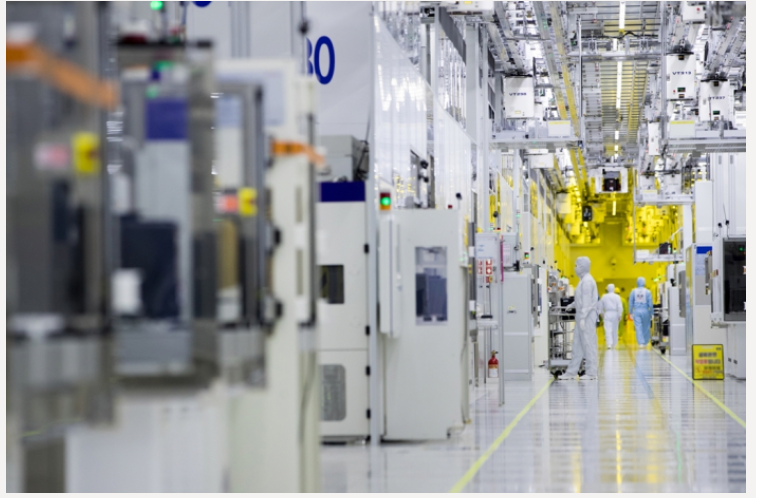
Samsung’s Human-less vision: A cold, silent efficiency that eliminates labor volatility.
Samsung management is no longer viewing labor as a mere “cost” but as a “Volatility Risk”—similar to a low yield or a broken supply chain. This realization is rapidly accelerating Samsung’s 2030 Human-less Fab Roadmap.
Samsung’s 2030 roadmap for a completely unmanned semiconductor fab isn’t just a tech goal anymore; it’s a Business Continuity Plan (BCP). By removing the Human Variable from the high-stakes cleanrooms, Samsung can stabilize its yield and supply chain from the volatility of labor unions.
Every day the strike continues, the ROI for AI-driven autonomous factories increases. Samsung is already funneling capital into the Smart Control System (SCS), which digitizes the intuition of veteran engineers into AI models.
For Your Information: The Rigid Reality of Korean Labor
A critical context for global investors is the extreme rigidity of the South Korean labor market. Under local law, it is nearly impossible for a company to lay off regular (full-time) employees once they are hired, except under very narrow and extreme circumstances. This means Samsung cannot simply replace its current workforce with robots overnight. The transition to an unmanned fab is not just a technical challenge; it is a long-term structural battle against a legal framework that treats labor as a fixed, permanent liability. Whether Korean society will permit such a massive shift in its social contract is a point of significant skepticism.
💡 Plan B Insight
The strike is loud, but the automated machines of the future are silent. If Samsung successfully pivots this crisis into an accelerated automation drive, the Labor Risk will eventually be replaced by Automation Premium. However, this is a high-stakes gamble against both technology and deeply entrenched social norms. Don’t just watch the picket lines; watch whether Samsung can navigate the Jeonggyujik (Regular Employee) rigidity to achieve its AI-managed vision.
All content on this blog reflects my personal investment journey and is not financial advice. Investment decisions and their outcomes are solely your responsibility.