INSIGHT The Dual Structure of the Korean Market
The South Korean stock market operates on two primary engines: the KOSPI (Main Board) and the KOSDAQ (Secondary Board). While they may seem similar to the NYSE and NASDAQ at first glance, the unique industrial landscape and regulatory environment in Korea present a distinct set of characteristics that global investors must navigate.
1. KOSPI vs. KOSDAQ: Defining the Market DNA
The KOSPI is the backbone of the Korean economy. It is home to global giants like Samsung Electronics, Hyundai Motor, and SK Hynix. This market is characterized by established, large-cap companies with stable dividend policies, attracting the majority of foreign and institutional capital.
The KOSDAQ is the stage for innovation and high-growth potential. It primarily hosts promising SMEs and venture companies in IT, software, biotech, and K-content. While it offers higher volatility, it is where global investors look for the next big thing in Korea’s tech and bio scenes.
2. Sector Weight Analysis (2026 Estimate)
While IT and Semiconductors are the core of both markets, the flavor of each index differs significantly.
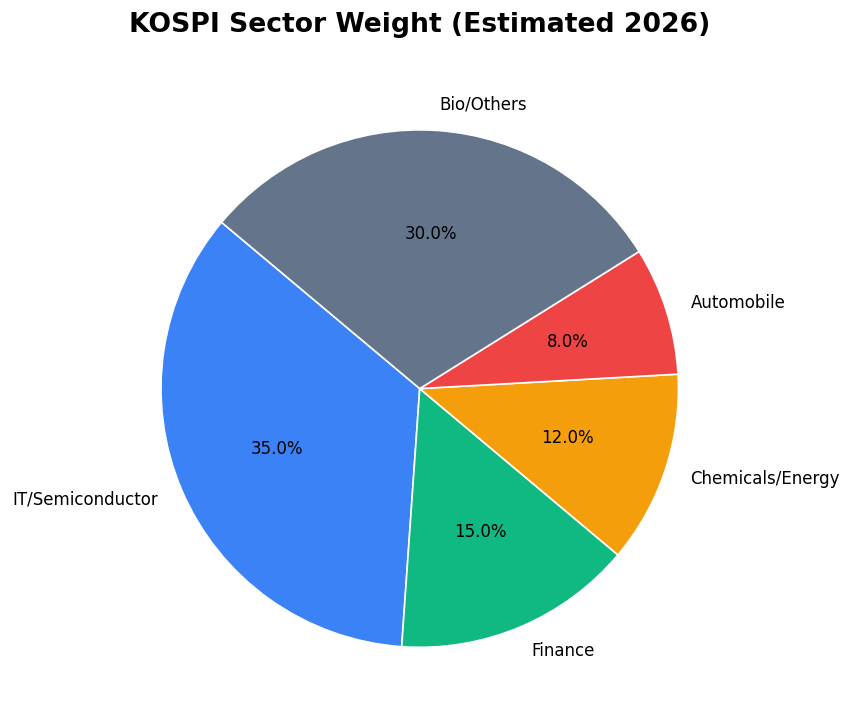
The KOSPI is dominated by Semiconductors and Hardware. Recently, the weight of the Finance and Energy/Chemicals sectors has also remained substantial due to the Value-up initiatives. In contrast, the KOSDAQ offers a much more diverse tech-centric portfolio.
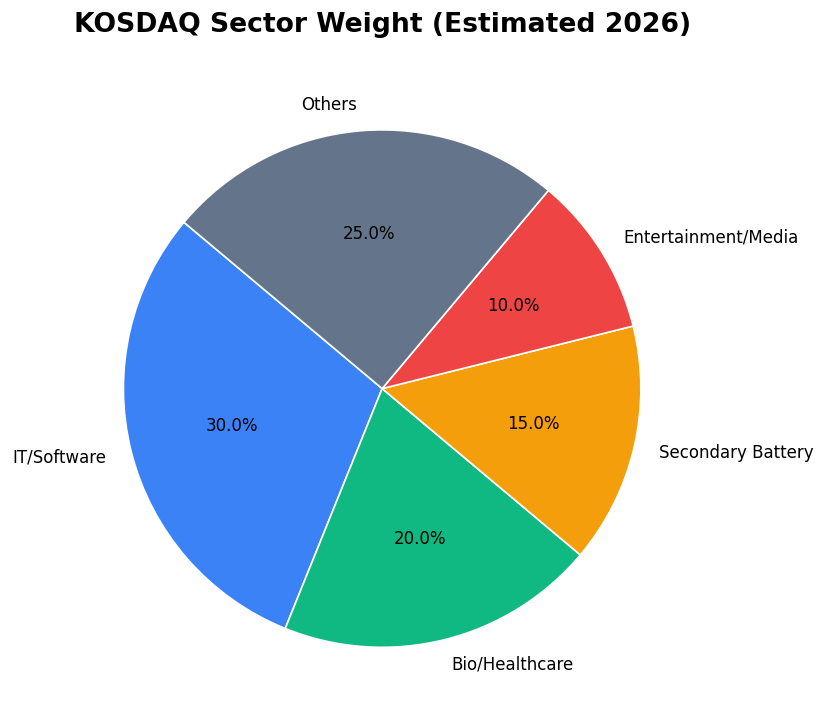
On the KOSDAQ, Biotech/Healthcare, Secondary Battery Materials, and Entertainment/Media wield absolute influence. If you want to tap into Korea’s cultural soft power (K-Pop) or its dominance in the EV supply chain, KOSDAQ is the index to watch.
3. Representative ETFs: How to Buy the Market
If the volatility of individual stocks is a concern, index-tracking ETFs are an excellent alternative for broad exposure.
- KOSPI 200: Tracks the top 200 companies on the KOSPI. KODEX 200 and TIGER 200 are the most liquid and widely traded ETFs in Korea.
- KOSDAQ 150: Captures the top 150 growth leaders on the KOSDAQ. KODEX KOSDAQ 150 is a must-have for those seeking aggressive growth exposure in the tech sector.
4. Focus on Names, Not Just Numbers
One of the biggest hurdles for global investors in the Korean market is the ticker system. Unlike the alphabetical tickers (e.g., AAPL, NVDA) used in the US, Korea uses 6-digit numerical codes (e.g., Samsung Electronics is 005930).
Key tips for navigating the system:
- The Name is the SSOT: Numbers are hard to remember and prone to typos. Local traders and institutions communicate primarily through stock names.
- The Preferred Stock Trap: Samsung Electronics Common Stock is ‘005930’, but its Preferred Stock is ‘005935’. Distinctions are often made by the last digit. Confusing these can lead to significant execution errors.
To succeed in Seoul, you need to look beyond the digits and understand the Stock Names and their suffixes like 우(Preferred). This local lens is what prevents costly mistakes and reveals true alpha.
5. The ±30% Price Limit
A Double-Edged Sword Unlike the US market, which uses circuit breakers but generally lacks hard daily price ceilings, South Korea enforces a ±30% daily price limit. Once a stock hits its upper or lower limit, trading effectively freezes at that price for the rest of the day. For global investors, this means that during extreme volatility, you might find yourself unable to exit or enter a position even if you are willing to pay the price. It’s a safety net that occasionally turns into a trap.
6. The Dividend Renaissance – Farewell to Blind Investing
Historically, Korea had a blind dividend system where investors had to buy stocks before knowing the exact dividend amount. This is changing. Under the Value-up Program, many top-tier companies are shifting to the global standard: announcing the dividend amount first, then setting the record date. For cash-flow-focused investors, this Dividend Renaissance makes the Korean market significantly more predictable and attractive for long-term income strategies.
7. Market Players – The Power of Ants
The Korean market is unique in its high participation rate of individual investors, affectionately called “Ants” (개미 – Gaemi). While institutional and foreign investors often drive long-term trends, the sheer volume and retail sentiment of the Ants can create explosive movements in sectors like secondary batteries or bio-tech. To trade in Seoul, you must keep an eye on foreign net buying (the smart money) while respecting the momentum driven by retail passion.
8. Trading Hours & The “Night Watchman” Effect
The main KRX market currently operates from 09:00 to 15:30 KST. Because Seoul is roughly 13-14 hours ahead of New York, the Korean opening price is often a direct reaction to the previous night’s Wall Street performance. We call this the “Night Watchman” effect—the US market sets the stage, and Seoul reacts.
However, the landscape is shifting toward significantly longer access:
The Rise of NXT (ATS): Korea’s first alternative trading system, NXT, is now fully operational, offering extended trading hours from 08:00 to 20:00 KST for a selected list of liquid stocks and ETFs. This narrowing of the time gap is a game-changer for global participants.
KRX Extension Plans: To further align with global standards, the KRX is also finalizing plans to extend its main trading hours beyond the current 15:30 close, moving toward a more flexible schedule that caters to international time zones.
Additionally, remember that Korea follows a T+2 settlement system; cash from a sale won’t be available for withdrawal until two business days later.